
極地の氷と、常夏の珊瑚礁。一見すると交わることのなさそうな二つの領域に身を置く研究者が、「科学と芸術」という共通語を手がかりに、腰を据えて語り合う機会を得ました。
Polar ice and tropical coral reefs—two domains that would seem unlikely ever to intersect. Yet it was under the shared language of “science and art” that we found ourselves in sustained conversation.
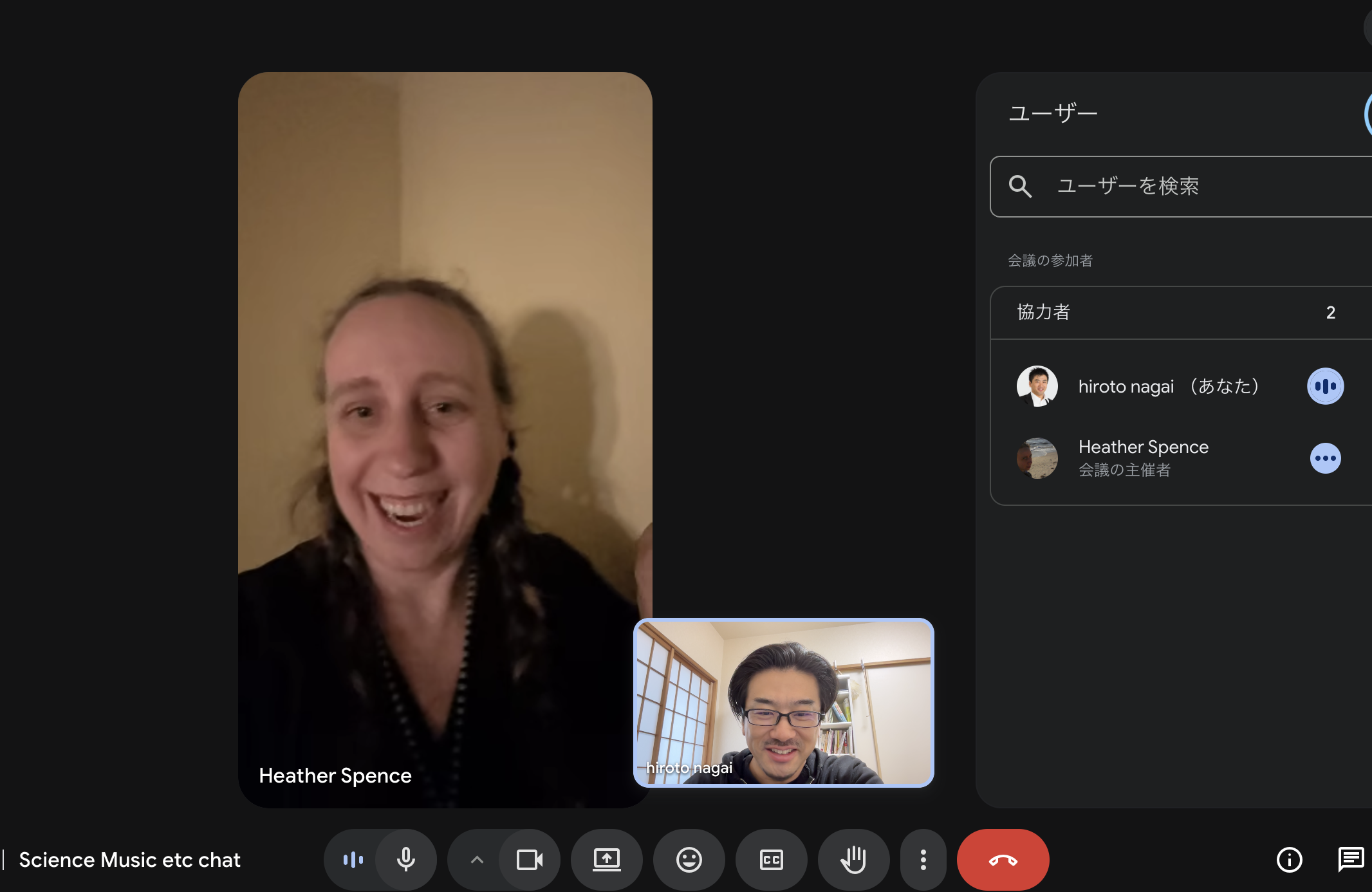
米国でScience & Artの学際領域、とりわけ音響を軸に活動されている Heather Spence 博士に初めて直接お会いしたのは、一昨年の米国地球物理学連合大会(AGU24)でした。招待講演に登壇し、海洋音響とアートを横断する実践を紹介されていました。
海中にハイドロフォンを設置し、珊瑚礁の生物が発する音を丁寧に録音し、それらを科学的に解析するとともに、環境音を素材とした音響作品を制作していること、またそれとは別に、ご自身がチェロ奏者・歌い手として演奏活動も行っていることが紹介されました。
録音された海の音の研究と、身体を通した音楽表現という二つの実践が、それぞれ独立しながらも一つの視野の中に置かれていた点が印象的でした。研究発表でありながら、理論と感性の繊細さが共存する講演は、今も記憶に残っています。
I first met Dr. Heather Spence at the American Geophysical Union Fall Meeting (AGU24) two years ago. Based in the United States, she works at the intersection of Science & Art, with a particular focus on sound. As an invited speaker, she presented her interdisciplinary practice spanning marine bioacoustics and artistic inquiry.
She described how she deploys hydrophones underwater to carefully record the sounds produced by coral reef organisms, and how these recordings are analyzed scientifically. She also produces acoustic works using environmental sound as material. Separately, she is active as a performing musician, presenting works for cello and voice.
What stood out was how these two strands—the scientific study and creative use of recorded ocean sound, and her embodied musical performance practice—remained distinct yet were situated within a shared intellectual horizon. Although it was a research presentation, the lecture carried a compositional coherence, where theoretical rigor and refined sensibility coexisted with ease.
彼女の実践は、単に「海の音を聴く」という行為にとどまりません。人間はどのように音を知覚し、そこにどのような意味を読み取るのか。認知科学や心理学の視点を踏まえながら、音を情報として扱うだけでなく、経験としても捉えようとします。
音はデータなのか、体験なのか。聴覚は科学的理解を補助する装置なのか、それとも思考の枠組みそのものを拡張する契機となるのか。そうした問いを、研究と制作の両面から静かに掘り下げている姿勢に、独自の厚みを感じました。
What distinguishes her practice is that it goes well beyond the act of “listening to the sea.” She asks how humans perceive sound and how meaning is constructed through hearing, drawing on perspectives from cognition and psychology.
Is sound information, or is it experience? Is listening merely an aid to scientific understanding, or might it reconfigure the very framework of thought? These questions are pursued simultaneously through research and artistic production. In this sense, her work moves fluidly between practice and theory within the field often described as Science & Art.
先日出版された、私のデータ・ソニフィケーションに関するNatureの取材記事をきっかけに、あらためてご連絡をいただきました。極地のエネルギーバランスや衛星観測データを音に変換する試みと、海中で直接拾い上げた生の音を作品へと昇華する試み、一見すると距離のある二つの方法ですが、共通する関心が浮かび上がってきます。
More recently, she reached out again after reading the Nature article on my work in data sonification. My own efforts have focused on transforming polar energy-balance and satellite observation data into sound, whereas her work begins with live environmental recordings gathered underwater and shaped into composition. At first glance, these approaches appear distant. Yet in conversation, a shared concern emerged: how might one construct a bridge between data and perception?
データと感覚のあいだに橋を架けることは可能か。音は説明を補う道具なのか、それとも思考を組み替える媒介となりうるのか。
Is sound simply a supplementary explanatory device, or can it function as a medium that reshapes thought itself?
やがて話題は、共作の可能性へと及びました。氷河や雪氷の世界である極地から、色彩に満ちた珊瑚礁へー
衛星が捉えた俯瞰的なデータの音と、海中で録音された環境音を並置し、そこに楽器演奏を重ねる。遠隔観測と現場録音、抽象と身体。それぞれが自立しながらも同じ時間の流れの中に置かれる構造は、ある種の交響的な広がりを想起させます。
ただし、それは美しい比喩として語るだけでは十分ではありません。どのような構成で、どのような論理で組み立てるのか。その設計こそがこれからの課題です。
氷と珊瑚礁、衛星とハイドロフォン、数値と生音ー
それらが一つの空間で響き合うとき、地球環境をめぐる語りはどのように始まるのでしょうか。構想はまだ芽生えたばかりですが、対話は自然に始まりました。
The discussion gradually turned toward the possibility of collaboration. One might imagine a movement from the cryosphere—glaciers and snowfields—to the vibrant ecosystems of coral reefs.
Satellite-derived, synoptic data sonifications could be placed alongside underwater environmental recordings, with instrumental performance woven through both. Remote sensing and in situ listening, abstraction and embodiment—distinct layers, yet unfolding within a common temporal structure. The configuration evokes something symphonic in character. Still, such a metaphor is only a beginning. The essential question lies in design: how to construct the work with conceptual rigor as well as artistic coherence.
Ice and reef, satellite and hydrophone, numerical data and living sound…
When these elements resonate within a single space, how might our ways of narrating Earth’s environment expand? The project remains at an early stage, but the dialogue has naturally begun.